Total pageviews

Tuesday, July 31, 2012

Teachings Of The Eagle Feather, Part 1


"Growth Is A Mystery"

- Updated: May 19, 2022

Niigiwin manidoowan storyteling ringss


A Sacred Love Story


Boozhoo, hello! I consider it an honor to be able to share with you the love story of these rings, which I made of 14K white gold and 14K yellow gold. The smaller of the two rings shown features a beautiful natural emerald stone cut in a marquise brilliant shape. The rings - which serve as teaching tools and are not for sale - tell a tale whose meaning, I believe, is deeply rooted in the collective memory and cultural consciousness of the people of my ancestors, the Ojibwe Anishinaabeg from the North American Great Lakes are.

It's not just a love story that I'd like to share with you; it's a SACRED love story, which I will tell again and again, in this blog and elsewhere, simply because it tells us so much about ourselves and where we came from...


Niigiwin Manidoowan


These elegant white gold relation rings are titled niigiwin manidoowan, which means “growth is a mystery” - lit.: “birth is a spirit.” Needless to say that the design of the rings tells a story of the physical and spiritual bond between two individuals, two lovers if you like. In a broader perspective however, the rings represent the organic commitment between a couple and the primary sources of life, our mother the earth and our father the sky. So, in a way, the combination of the symbol of the eagle feather and the color and shape of the green emerald (symbolizing growth) in the woman’s ring tells a story of the couple wearing the set...


The first Sound of Creation


The 0.24” X 0.12” marquise-cut emerald, mounted in a yellow gold bezel, symbolizes miinikaan (a seed); the precious stone stands, in color and form, for the fertile earth in springtime, when the seeds sprout forth from the earth and life returns to the land. It represents the bursting of the seed of affection in our heart for someone we love. It also epitomizes the first sound of creation, and the time of day we call morning. In addition, the stylized eagle feathers of white gold adorning both rings suggest the omnipresence of the sky and the light of the eastern direction and, in a metaphorical sense, something called manidoowiwin: the spiritual quality surrounding us in life.

Niigiwin manidoowan rings


Earth's Medicine 


All these entities, earth and sky, birth and rebirth, the magical connection between the material and the immaterial and between fertility and the light of day, come together in the ring design and represent the deep and organic love that two people are capable of feeling for each other.


Manidoowi miinikaanense.
Niigiwin manidoowin.
Miinikaanense w'da-gikinaawajinowaan abinoojiin.
Miinikaanense manidoowi, w'da-mashki-akiiwi.

"The small seed is a mystery.
Birth is a mystery.
The small seed symbolizes a child.
The small seed is mystical, it will heal like earth's medicine."

- Ritual words of thanksgiving of the Waabanoowiwin, Anishinaabe Society of Dawn


_____________________________________________________________________

Read the second episode in the Teachings of the Eagle Feather series: A Prayer to the North.


_____________________________________________________________________

About me and my sources of inspiration:


Zhaawano Giizhik at Agawa Rock

My name is Zhaawano Giizhik. 


As an American artist and  (non-commercial) jewelry designer currently living in the Netherlands. I like to draw on the oral and pictorial traditions of my Ojibwe Anishinaabe ancestors from the American Great Lakes area. For this I call on my manidoo-minjimandamowin, or "Spirit Memory"; which means I try to remember the knowledge and the lessons of my ancestors. The MAZINAAJIMOWINAN or ‘‘pictorial spirit writings’’ - which are rich with  symbolism and have been painted throughout history on rocks and etched on other sacred items such as copper and slate, birch bark and animal hide - were a form of spiritual as well as educational communication that gave structure and meaning to the cosmos. Many of these sacred pictographs or petroforms – some of which are many, many  generations old - hide in sacred locations where the manidoog (spirits) reside, particularly in those mystic places near the coastline where the sky, the earth, the water, the underground and the underwater meet.


Tuesday, July 17, 2012

Reflections of the Great Lakes, part 5


"The Spirit of ᒪᓅᒥᓐ Manoomin"


ZhaawanArt Manoomin bracelet image 1, designed and handmade by Zhaawano Giizhik


Aaniin! Hello!


By way of a blog series called "REFLECTIONS OF THE GREAT LAKES," accompanied by paintings, graphic art, and jewelry designs, I aspire to capture, and pay homage to, the spirit and beauty and majesty of GICHIGAMIIN, the Great Seas of the Anishinaabe People. A natural resource of immense proportions once respected, revered and held sacred, yet nowadays unappreciated by many, its ecosystem largely being exploited by numerous large mining corporations.

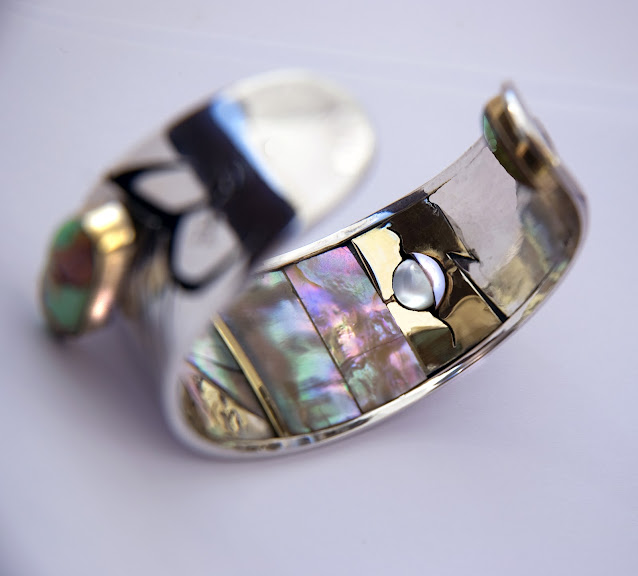
The “story bracelet” - which is not for sale - featuring today's story is made of sterling silver, 18K yellow gold, and turquoise; the piece has inlay of turquoise, white shell, mother-of-pearl, red coral, 14k and 18K yellow & red gold on the inside.


Wisconsin Historical Society

______________________________________________________________________________


Manoominike Giizis: Mii o’apii manoominiked a’aw Anishinaabe - Apii idash maajiigid dibik-giizis idash bagamibizod zhiishiib. (In The Rice-Making Moon: When The Anishinaabe Picks Rice - When the Moon Grows Fat And The Wild Duck Flies) 
________________________________________________________________________________

Manoomin teaching bracelet

I designed this storytelling bracelet as a tribute to manoomin (the wild rice), Manoominike Giizis (the month of August/September), and the natural beauty of zaaga’iganan: the freshwater lakes of the northern country. The bracelet design also expresses my admiration for the brilliant work of the late Hopi spiritual leader and jeweler Charles Loloma – a member of the Badger Clan and a snake priest whose painterly and contrasting jewelry-making style was derived from the colors and contours and patterns of the rugged terrain of his own ancient homeland, deep in the American Southwest.

Although far less wild and exotic, perhaps more clean and delicate than Loloma’s work, and characterized by a “northerly” fashion that was unknown to this master metal craftsman from the Southwest who became world-famous by his sculptural tufa cast jewelry, the “storytelling” designs on (the underside of) the Manoomin bracelet are - remotely- reminiscent of one of Loloma’s early findings: the lining of the interiors of rings and bracelets. Like Loloma and other contemporary Native jewelers influenced by him, I like to think of these inlaid – and sometimes overlaid – interiors not only as themes that tell a story: I call them the soul of my jewelry.

INLAY is a technique initiated by Native silversmiths from the American Southwest, in which a decorative pattern of stones or shell is set into the silver or gold interior or exterior of a piece of jewelry. Charles Loloma’s early "height bracelets" for instance were characterized by multi-colored relief patterns, with the inside of the same piece sometimes lined with intricate mosaic. Irregularities in sizes and shapes of decorative stones were equaled by free forms in the total pieces of this master jeweler, the old and the new always meeting in his sophisticated work.


________________________________________________________________________________

THE STORY OF THE BRACELET


Great Lakes wild rice harvest


Noongom isa, giwii-dazhindamoon anishinaabe-manoominikewin.

 "Now, I'm going to tell about Ojibwe ricing."

When in the heart of Anishinaabe Aki (Ojibwe land) the leaves of wiigwaasatigoons (the young white birch) start to turn yellow and asasaweminagaawanzh (chokecherry) ripens, then grandmother moon begins to wax and the Anishinaabeg start canoeing their freshwater lakes and rivers gathering their sacred grass: manoomin, or ᒪᓅᒥᓐ written in Ojibwe syllabics, the food-that-grows-upon-the-waters, foretold in the Ojibwe Midewiwin migration prophecy. Traditionally, after the harvest and landing back on shore, the Anishinaabe ricers thresh the freshly harvested grain by dancing on it.


Within living memory, manoomin (wild rice, literally "mystery seed") has fed the mouths, the hearts, and the spirits of the Anishinaabe Peoples that live at, or nearby, Gichigamiin, the Great Lakes. Traditionallly, manoomin forms the chief cereal food in many a southern Anishinaabe community, from some areas in the east (present-day Michigan) to the Lakes region farthest to the west (present-day Minnesota). It abounds in several lakes, ripening earliest in the shallow ones fed by streams, and later in the lakes fed by springs. By a wise provision of nature the seed of manoomin is carried southward by the plump, ring-necked zhiishiib – the wild duck- which the People hunt during Manoominike-Giizis, the Rice-Making Moon, the season the Euro Americans call the months of August/September.


While “ricing” is traditionally an industry essential to food supply and trade, it has, like the maple sugar camp in the Maple-Sugaring Moon (April), a pleasant social phase, which is why the southern Anishinaabeg gave manoomin an honored place in their culture. Even when someone passes on to the Spirit World, the People offer manoomin for the spirit/soul to travel its journey. Also, in the long ago the Great Mystery blessed the sleep of certain chosen people with the knowledge of manoomin and these “Rice Dreamers’’ showed their fellow band members how to feed themselves with the sacred grain.


Manoomin wild rice Ojibwe nooshkaachinaagan

Harvesting Manoomin also carries a spiritual meaning related to the connection between man and woman. When gathering the wild rice, a Nishnaabewinini and a Nishnaabekwe venture out in their own canoe without any additional company. This display of unity between male and female and their shared contribution to the spirit of manoomin ensures a successful harvest and safeguards them from any harm while on the lake.

Detail of "Rice dreamers"" painting by Zhaawano Giizhik


To this day, manoominike is the activity that most enlivens Anishinaabe sense of identity. It is simply a way of life, which, however, becomes more and more threatened by changes in the water level and toxic waste and heavy metals from the factories and mines that used to belong to companies like Exxon - which have gradually but dramatically turned today’s Great Lakes into one big mining district.

According to Ojibwe Anishinaabe tradition, Wenabozho, the beloved supernatural hero of the Anishinaabeg, known as the first man who walked the earth, was introduced to manoomin by fortune, and by a duck.

"One evening Wenabozho returned from hunting, but he had no game ... As he came toward his fire, there was a duck sitting on the edge of his kettle of boiling water. After the duck flew away, Wenabozho looked into the kettle and found manoomin floating upon the water, but he did not know what it was. He ate his supper from the kettle, and it was the best soup he had ever tasted. Later, he followed in the direction the duck had taken, and came to a lake full of manoomin: the sacred berry, nowadays called wild rice. He saw all kinds of ducks and geese and mud hens, and all the other water birds eating the grain. After that, when Wenabozho did not kill a deer, he knew where to find food to eat...."

________________________________________________________________________________

SYMBOLISM OF THE BRACELET


Manoomin story bracelet


The smooth and simply stylized exterior as well as the sophisticated, vary-colored interior of the bracelet are reminiscent of the once quiet and perfectly natural world of my Anishinaabe ancestors.

It is a world that can best be visualized by closing one’s eyes and imagining the peaceful sounds of paddles slicing the calm waters of a lake on a quiet autumn night - or of bawa’iganaakoon, smooth cedar rice vanning-sticks, gently knocking on stalks of manoomin in the daytime. 


Manoomin bracelet serves as teaching tool


The slightly concave form of the smoothed outer band of the bracelet – symbolizing the moonlit surface of a freshwater lake in the quiet season - sets off a lovely, free-form turquoise elegantly set in 18K gold. The unusual green color of the stone represents the sacred and nourishing powers of manoomin – the sacred gift from GICHI-MANIDOO to the Anishinaabeg. This protruding stone, which can be seen as the inner strength, or the spirit of the plant, dramatically tops the abstract Medicine Painter-like image of manoomin that is adorning one end of the bracelet’s exterior – and which I executed in the technique of overlay. The opposite end of the band I decorated with -identically stylized - images representing knocked kernels of manoomin in the first stage of preparation. The black - oxidized - color of the kernels pertains to the color of makadewiminigad, or black seed-grain, which is created by letting the kernels dry in the sun.


Wild Rice story bracelet by Zhaawano Giizhik


The seven panels (seven is a sacred number) that I created to line the interior of the bracelet express several interrelated themes, or scenes from Anishinaabe life. Some of these I fashioned by texturing the silver (with a soldering torch) or with the technique of overlay, along with the abstract graphic style of the Medicine (Woodland) Painters.

On the far left I depicted wayiiba da-biboon or the cold weather of soon-approaching winter, represented by the textured imprint of the silver inlay; silver rice beds illuminated by images of the night-sun and the celestial bodies (a touch of red coral represents ningaabi’anang, the evening star, symbol of the west) have been depicted to the right; adjoining are several thin slices of brilliant mother-of-pearl, symbolizing the reflection on the lake’s surface of giizhigaate, the light of the moon; and, farther to the right, I fixed into a panel of 18K yellow gold sheet, giizis bajiishkiwine, or a (red gold) crescent moon, gradually waxing into a giizis waawiyezi or a full moon. This I made from a dome shaped moon stone cabochon. 


Interior of manoomin storytelling bracelet


Since the Anishinaabeg regard zhiishiib and the snipe – a wading bird they call manoominikeshii, the ricing-bird – as special messengers, a sure sign of ripe grain, I created with the technique of overlay - in a graphic style resembling the abstract outline drawings of the Medicine Painters - a silver image of a startled water bird flying over a golden rice bed.

This image of the startled bird visualizes the relationship between the waterfowl and manoomin and the People who so heavily depend on both.


Inlay storyteling bracelet


Finally, I fixed to the ends of the interior(!) of the band two attractive brown-speckled turquoise cabochons, one green and one blue, representing the earth and the sky – like opposite sentries guarding the stilled scenery of the moonlit rice beds. Both stones add an unusual finishing touch to the overall design, honoring in color and form the Rice-making Moon, the annual rice harvest, and all that is quintessentially Anishinaabe…

Giiwenh. Miigwech gibizindaw noongom mii dash gidibaajimotoon.

So the story goes. Thank you for listening to me today, to allow me to tell you this story.

________________________________________________________________________________

Jewelry image: Manoomin, Spirit of the Wild Rice - storytelling bracelet of sterling silver, 18K yellow gold, turquoise; inlay of turquoise, white shell, mother-of-pearl, red coral, 14k and 18K yellow & red gold on the inside. The bracelet serves as a teaching device and is not for sale. Jewelry photography: Zhaawano Giizhik.

Image of painting: 
Detail of "Rice Dreamers," painting by Zhaawano Giizhik (2026)
________________________________________________________________________________
                         
                                                  
Ojibwe manoomin wild rice


Click here to go to the PETITION "PROTECT OUR MANOOMIN FROM LARGE-SCALE SULFIDE MINING IN THE GREAT LAKES AREA!"

Click here to read #6 in the series Reflections of the Great Lakes. 

________________________________________________________________________________

                                      
Zhaawano Giizhik Tammo Geertsema About the author/artist:
Zhaawano Giizhik, an American currently living in Amsterdam, the Netherlands, was born in 1959 in North Carolina, USA. Zhaawano has Anishinaabe blood running through his veins; the doodem of his ancestors from Baawiting (Sault Ste. Marie, Upper Michigan) is Waabizheshi, Marten. As a writer and non-commercial artist and jewelry designer, Zhaawano draws on the oral and pictorial traditions of his ancestors. In doing so he sometimes works together with kindred artists. 


________________________________________________________________________________


Monday, July 16, 2012

Teaching Stories, part 9

Gichigami storyteller ring banner

"Walking The Sacred Path Of Life"


- Updated: November 3, 2018

Life Road storytelling rings by Zhaawano Giizhik


______________________________________________________________________________

Gaawiin bekaanizid awiya odaa’aanjimokibidoosiin anishinaabemowinan gaye gagiikwewinan, giinawind gidaawimin...

"There is nobody else who can revitalize our culture and values except ourselves. Life is what we make of it."


- Anishinaabe proverb
*
______________________________________________________________________________

Boozhoo! Hello! I consider it an honor to share with you today the sacred story of these gold rings. The rings serve as teaching tools and are not available for purchase. 

The story of the rings has been told throughout history, its meaning deeply rooted in the collective memory and cultural consciousness of the Anishinaabe Peoples. It's also a story that's quintessentially universal in its scope and in its applicability to our everyday lives and relationships.


______________________________________________________________________________


Midewiwin Life Road rings by ZhaawanArt
Teaching rings titled: Mino-bimaadiziwin/Giizis-babaamaadiziwin (The Way of the Good Life/ Path of the Sun). 
______________________________________________________________________________

The outer surfaces of the rings feature a stylized representation of the Midewiwin Miikana diagram, also known as Anishinaabe mino-miikana: the Good Life Road of the People. The inner surfaces show the daily journey of Gimishoomisinaan giizis, our grandfather the sun, who is our Lifegiver, providing us with light, warmth, and energy.

The Life Path design of the rings symbolically aligns with the earth's rotation around the sun and the sun's daily journey from east to west. Gete-ayaa’ag, the ancestors, viewed the Road of Life as a cyclical journey, akin to the changing seasons and the day-night cycle.

The spherical overlay symbols within both rings depict the sun. The yellow gold interior of the ring on the right signifies waaban, the morning light from the east, and mookise giizis, the rising sun; the red glow inside the other ring represents bangishimo giizis, the setting sun in the west.

Therefore, the ring set, with its ancient Life Road design, cosmically connects the love between two life partners with the sun, the seasons, and the cycle of day and night. 


Teachings of the Midewiwin


The teachings of MIDEWIWIN, the Medicine and Ethics Lodge of the Anishinaabeg Peoples, convey that each individual has a path to follow, known as The True Path of Life. This unpredictable journey includes many deviations (dangers and temptations) and traverses four "hills": infancy, youth, adulthood, and old age. Originally illustrated by the ancestors on ancient, sacred birchbark scrolls, this life path is shown as a stylized trail with seven or nine deviations or lines branching from the main path of life. Preserved securely within the Mide spiritual practices, the teachings of the True Path of Life have been handed down through many generations.


For a Midewiwinini or Midewekwe - Mide man or Mide woman -, straying from Bimaadiziiwin-Miikana, the true path of life, without returning is equivalent to dying.However, since deviation is rarely permanent, it is expected that he or she will annually retreat in vigil and prayer to seek guidance from the aadizoogaanag (spirit helpers) and reflect on their life to determine if they remain on the true path. 


Midwiwin Life Road diagram


A good way of life

The name of these Mide path story rings, Mino Bimaadiziwin, translates to "A Good Way of Life." It embodies the way the People should live to achieve good fortune, good health, and inner peace in this life, and to enter the Land of Peace in the afterlife. In Anishinaabe society, material wealth does not elevate a person's status. Only bravery, skill, and respect for children, elders, and the sacred web of life lead to mino-bimaadiziwin, a good way of life. 

Storytelling rings Gichigami

For traditional Anishinaabeg, living a good way of life is the primary goal. Achieving this goal requires personal effort and the assistance of specialists, such as medicine persons, as well as the effective help and cooperation of certain nonhuman entities known as aadizoogaanag (“our grandfathers” or spirit-helpers), who exist throughout all layers of the universe. Reciprocal responsibilities and mutual obligations are assumed as a matter of course, not only among humans but also in relation to all life forces and beings in the world. 

Inaabandamowinan (dreaming) or pursuing waasayaabindamiwin (a vision) are the main ways to engage in direct social interaction with nonhuman entities. Upholding a high moral standard within Anishinaabe society, respecting the principle of mutual obligations among all life forms, and acquiring power from both aadizoogaanag and bawaajiganag (grandfathers and ancestors appearing in dreams) are equally crucial for achieving Bimaadiziwin.

Giiwenh. That's how far the story goes. Thank you for reading & listening.

________________________________________________________________

Read the next episode in the "Teaching Stories" series: Heartbeat of the Earth.

*Source: The Seven Sacred Teachings

Image storytelling rings by ZhaawanArt. "MINO BIMAADIZIWIN": overlay rings, 14K white gold, red gold, yellow gold by ZhaawanArt. The rings serve as teaching tools and are not for sale.


________________________________________________________________


About the artist and his sources of inspiration:


Author and artist Zhaawano Giizhik at Agawa Rock


Zhaawano Giizhik, an American currently living in Amsterdam, the Netherlands, was born in 1959 in North Carolina, USA. Zhaawano has Anishinaabe blood running through his veins; the doodem of his ancestors from Baawiting (Sault Ste. Marie, Upper Michigan) is Waabizheshi, Marten.

As a writer and non-commercial artist and jewelry designer, Zhaawano draws on the oral and pictorial traditions of his ancestors. In doing so he sometimes works together with kindred artists.

Photo: the artauthor at Agawa Rock, Ontario. Photo by Simone McLeod.


Sunday, May 13, 2012

Artist Inspirations, part 3


The True Legacy of Ogimaa Oboonidiyak (Chief Pontiac)


_______________________________________________________________________________


Chief Pontiac storytelling bolo tie

The Rise and Fall of Chief Pontiac


Once in a while a person of exceptional intellect and creativity, from the past or the present, inspires me into creating a painting, a graphic art work, a piece of jewelry, a poem… or a song. Today I like to share with you the remembrance of a great Anishinaabe Inini who lived two and a half century ago, and whose corrupted name – as it has been mangled through time in millions of strange mouths – is still widely known even today.


___________________________________________________________________________

About the author:


Zhaawano Giizhik at Agawa Rock


________________________________________________________________________________


My name is Zhaawano Giizhik. My clan is waabizheshi, the marten.

As a non-commercial artist and jewelry designer currently living in the Netherlands. I like to draw on the oral and pictorial traditions of my Ojibwe Anishinaabe ancestors from the American Great Lakes area. For this I call on my manidoo-minjimandamowin, or "Spirit Memory"; which means I try to remember the knowledge and the lessons of my ancestors. 

The mazinaajimowinan or ‘‘pictorial spirit writings’’ - which are rich with symbolism and have been painted throughout history on rocks and etched on other sacred items such as copper and slate, birch bark and animal hide - were a form of spiritual as well as educational communication that gave structure and meaning to the cosmos. 

Many of these sacred pictographs or petroforms – some of which are many, many  generations old - hide in sacred locations where the manidoog (spirits) reside, particularly in those mystic places near the coastline where the sky, the earth, the water, the underground and the underwater meet. 

It is these age-old expressions that provide an endless supply of story elements to my work – be it graphically, through my written stories, as well as in the context of my jewelry making. 

________________________________________________________

________________________________________________________________________________